

Let’s get this out of the way early: if people are landing on your store but not buying, ads are rarely the real problem.
Ads get blamed because they’re visible. You see the spend. You see the clicks. When sales don’t follow, it feels logical to point the finger there. But in most Shopify stores, ads are just the messenger. The real issues live on the store itself.
And they’re usually boring, unsexy, and very fixable.
Traffic Is Not the Same as Intent
Not all clicks are equal. A lot of Shopify stores technically get “traffic,” but that traffic isn’t being guided anywhere.
People land. They scroll a bit. They hesitate. Then they leave.
Why? Because the store doesn’t answer three basic questions fast enough:
What is this?
Is this for me?
Why should I trust it?
If a visitor has to think too hard to figure those out, you’ve already lost them. Attention online is fragile. Confusion kills conversion.
Related read: 5 Shopify SEO Fixes Every Store Should Implement Today
Your Homepage Is Trying to Do Too Much
Many Shopify homepages are trying to be everything at once. Brand story. Product catalog. Lifestyle magazine. Mission statement. Five popups fighting for attention.
The result is noise.
A good homepage doesn’t explain everything. It funnels people forward. It should clearly communicate what you sell, who it’s for, and what to do next. If the primary action isn’t obvious within the first few seconds, most visitors will bounce without ever seeing your products.
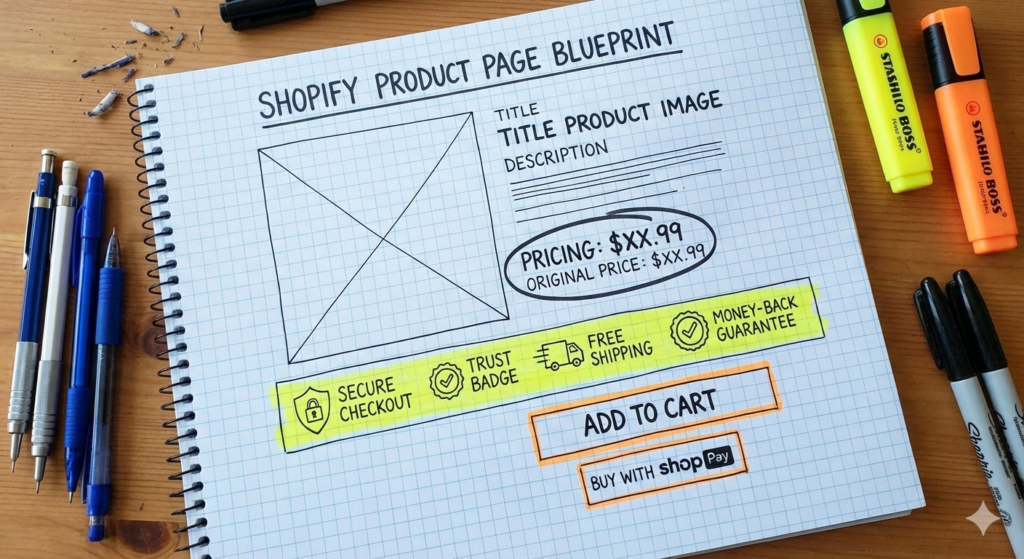
Product Pages Aren’t Pulling Their Weight
This is where conversions actually live, and it’s where most stores underperform.
Common problems show up again and again:
Product descriptions that describe features but not outcomes
No social proof, or reviews buried too far down
Weak imagery that doesn’t show the product in use
CTAs that don’t stand out or feel urgent
A product page isn’t a spec sheet. It’s a sales conversation. If it doesn’t reduce doubt and build confidence, it’s silently leaking revenue.
Trust Is Missing (Or Hard to Find)
You might be legit. Your visitors don’t know that.
Trust signals are often an afterthought on Shopify stores, but they matter more than people want to admit. Shipping clarity, returns policy, contact information, reviews, and even basic design polish all contribute to whether a store feels safe to buy from.
When trust is missing, price sensitivity goes up. People hesitate longer. Cart abandonment increases. Not because the product is bad, but because uncertainty creeps in.
Speed and Friction Are Quiet Conversion Killers
Slow load times don’t just annoy people. They change behaviour.
Every extra second a page takes to load increases drop-off. Every unnecessary step in the buying process adds friction. Excessive apps, bloated themes, and clunky checkout flows quietly sabotage otherwise good products.
The painful part is that store owners often don’t notice these issues because they’re already used to them. First-time visitors are not.
Ads Can’t Fix a Broken Funnel
Here’s the uncomfortable truth:
ads amplify whatever is already there.
If your store converts well, ads scale it.
If your store converts poorly, ads just burn money faster.
That’s why increasing ad spend without fixing fundamentals feels like pushing harder on a door that’s locked. The solution isn’t louder traffic. It’s a smoother path from landing to checkout.
Conversion Is About Clarity, Not Tricks
High-converting Shopify stores aren’t magical. They’re clear.
Clear messaging.
Clear product positioning.
Clear next steps.
They remove doubt instead of adding distractions. They respect the visitor’s time and decision-making process.
That’s the work that moves the needle. Not another ad campaign. Not another app. Not another “one weird trick.”
Need a Shopify developer / specialist to fix your store’s conversion issues?
Reach out and let’s see how we can improve your store.
Leave a Reply